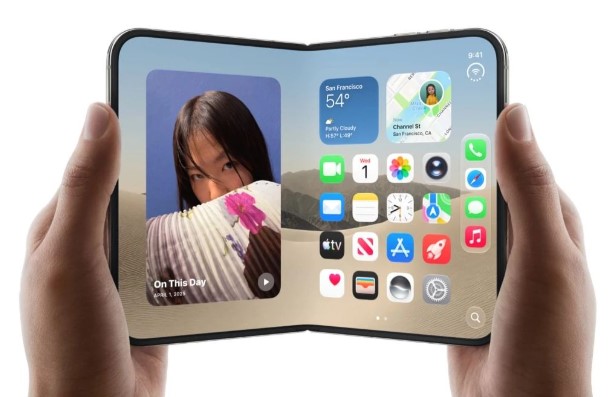
Behind Apple’s newly launched iPhone Duo lies a critical, often overlooked player: Samsung Display. The foldable screen inside the iPhone Duo is, in fact, made by Samsung.
Apple sources components for the iPhone Duo from suppliers around the world. But the display component most closely tied to its new form factor happens to be one of the hardest to source outside South Korea.
A Different Kind of Dependence Than the iPhone X Era
“With the iPhone X, Samsung’s OLED was simply a component that made the iPhone’s display better. This time is different. Without Samsung Display’s foldable panel, this form factor itself simply couldn’t exist,” a Korean display industry official told the Korea Herald.
Samsung Display was Apple’s exclusive OLED supplier when the iPhone X debuted back in 2017. But the similarities end there.
The iPhone X used Samsung’s flexible OLED to achieve an edge-to-edge display. The iPhone Duo is a fundamentally different challenge, given its actual folding screen.
That doesn’t mean Apple simply purchased an existing Galaxy-series panel off the shelf, either. According to the same industry source, Samsung Display manufactured the screen to Apple’s specific requirements, with Apple then designing everything else around that display.
At the launch event, Apple highlighted its own innovations around the hinge mechanism and the structural support beneath the panel, along with dedicated software built specifically for the inner display.
Samsung’s Multi-Year Head Start
Samsung Display’s advantage comes from years of experience mass-producing foldable OLED panels at scale. Samsung Electronics launched the first Galaxy Fold back in 2019.
Since then, Samsung Display has gone through multiple product generations, working to solve the most critical challenges tied to foldable screens, from crease visibility to long-term durability and manufacturing yield rates.
According to a report from The Elec earlier this year, Apple agreed to source foldable OLED panels exclusively from Samsung Display for up to three years.
“Apple typically prioritizes supplier diversification. If they’re entrusting the most critical component of their first-generation product to a single company, that says a lot about how difficult it is to find an alternative,” the official said.
Not Just the Display: Memory Dependency Too
Linda Sui, founder of Smart Analytics Global, agrees, noting that the iPhone Duo’s component sourcing relies heavily on South Korea for several critical technologies that are difficult to substitute.
“The clearest example is the foldable OLED display. Other display manufacturers can technically produce high-quality foldable OLED panels. However, meeting Apple’s requirements across every aspect while consistently supporting production of millions of units is a far higher bar to clear,” Sui said.
The display isn’t Apple’s only point of reliance on Korean suppliers. Samsung Electronics and SK Hynix are among the world’s leading suppliers of DRAM and NAND memory, alongside Micron in the United States. Their role has become especially significant amid surging memory prices that are driving up production costs across the industry.
Counterpoint Research estimates that memory costs are the primary factor behind an estimated nearly $300 increase in material costs for the 1TB iPhone 18 Pro Max variant compared to its predecessor.
Apple’s Uncomfortable Position
No teardown analysis has yet revealed exactly how much of the iPhone Duo’s total cost comes from Korean suppliers. Still, this dependency has reportedly placed Apple in an uncomfortable negotiating position.
“Apple typically uses its massive purchasing power to drive down component prices. With this product, that formula may be less effective for some key parts, particularly memory. Aside from Micron, there’s genuinely no alternative supplier outside of Korea,” the official said.
“Apple doesn’t need to prove it can make a foldable phone. Samsung has already proven that over the past seven years. Apple needs to prove why this foldable phone deserves a $1,999 price tag,” the official concluded.
The iPhone Duo’s launch reveals an interesting paradox at the heart of Apple’s foldable ambitions: the company that built its brand on tight vertical integration and supplier leverage now finds itself more dependent than ever on South Korean technology for its most important new product. Whether that dependency becomes a long-term vulnerability or simply a temporary growing pain for Apple’s foldable strategy will likely become clearer as competition in the foldable display market matures.